
Freelusion Turned the AGT Stage Into Another World
There are performances on America’s Got Talent that impress audiences with singing, comedy, magic, or incredible physical skills. And then there are performances that seem to completely change the rules of what can happen on a television stage.
Freelusion belongs firmly in that second category.
The innovative dance and projection-mapping group became one of the most memorable visual acts from America’s Got Talent Season 10 in 2015. Instead of simply performing a dance routine, Freelusion combined choreography, 3D graphics, projection mapping, storytelling, lighting, and technology to create the feeling of an entire fantasy world appearing around the performers.
Their performances left viewers asking the same question: “How did they do that?”
The group described itself as a 3D videomapping dance group, combining dance with spectacular visual technology. Their official YouTube channel still features their AGT performances, including the original audition and later stages of their journey.
A Performance That Was More Than Just Dance
When Freelusion first appeared on America’s Got Talent in 2015, the concept immediately stood out.
The performance was built around a dancer surrounded by changing digital environments. Through carefully synchronized projection mapping, the stage appeared to transform from one setting into another. Objects, landscapes, characters, and visual effects seemed to interact directly with the dancer.
What made the act particularly fascinating was the synchronization.
The performers weren’t simply dancing in front of a screen. Their movements were carefully integrated with the projected imagery, creating the illusion that the dancers were actually interacting with the digital world around them.
According to Freelusion’s description of the performance, the story was inspired by Adam and Eve, with the dancers moving through a world threatened by evil. One of the most striking moments involved the appearance of Eve through the visual effects.
For viewers watching at home, the effect was almost like watching a live-action movie being created in real time.
The Technology Behind the Magic
Projection mapping is what helped make Freelusion’s performances so different.
The technique allows projected images to be carefully aligned with physical surfaces and stage elements. When combined with choreography, the illusion can become extremely convincing.
Freelusion took that concept much further by designing the visual effects around the dancers’ movements.
A dancer could appear to run through a changing landscape, interact with animated objects, disappear into another environment, or become surrounded by effects that seemed to respond to every movement.
The result was a mixture of dance, theater, digital art, and technology.
The group had developed this style before its appearance on AGT. Freelusion was established in 2009 and focused on 3D projection mapping, interactive projection mapping, and augmented-reality-style experiences. The group had also appeared in other international talent competitions before reaching American television audiences.
From Audition to the AGT Live Shows
Freelusion’s journey on America’s Got Talent was more than a one-night viral moment.
The group first appeared during the Season 10 auditions in June 2015. Their audition combined dance and videomapping to tell a story involving a man, the creation of a woman, and a constantly changing digital environment. All four judges voted to move the group forward.
Their Judge Cuts performance continued the story and pushed the visual concept even further.
Freelusion advanced into the live shows, where the group continued developing the narrative. Their quarterfinal performance incorporated additional visual elements and continued the story of the characters confronting an evil presence. The performance received strong reactions from the judges and audience.
By the time Freelusion reached the semifinals, expectations were extremely high.
And that was when the group delivered one of its most ambitious performances.
The Giant Robot Moment
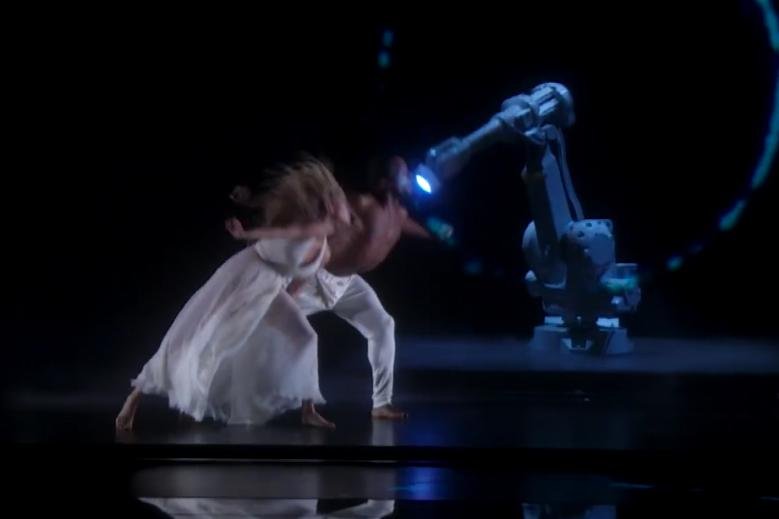
Freelusion’s semifinal performance became especially memorable because it introduced a real industrial robot into the production.
The group combined its projection-mapping choreography with an ABB robot, creating a confrontation between the dancers and a huge mechanical presence.
According to Freelusion’s own description of the performance, the show continued the Adam-and-Eve storyline and featured augmented-reality effects, scrim projection, 3D animation, and the robot approaching the judges’ area.
The effect was spectacular.
What initially looked like a normal dance performance suddenly became something much larger. The audience wasn’t simply watching dancers move across a stage; they were watching a story unfold between humans, technology, and a digital environment.
The combination of a real robot and projected imagery made it difficult to tell where the physical stage ended and the digital world began.
That is precisely what made Freelusion so memorable.
Why the Performance Still Gets People Talking
Freelusion’s performances remain fascinating because they feel different from traditional talent-show acts.
A singer can impress with a powerful voice. A magician can create an impossible illusion. A dancer can demonstrate incredible physical control.
Freelusion combined several of those ideas into one production.
Their performances required dancers, choreographers, visual designers, programmers, technical specialists, lighting professionals, and other members of a production team to work together with extremely precise timing.
Even a small timing error could potentially break the illusion.
Instead, the choreography and visuals were designed to work together as one experience.
This is also why the performances have continued to attract viewers online years after their original television broadcasts. Freelusion’s official YouTube uploads provide viewers with a chance to revisit the performances and see how the group’s concept developed throughout the competition.
A Reminder That AGT Is About More Than Traditional Talent
Freelusion also demonstrated how America’s Got Talent could provide a platform for emerging forms of entertainment.
The group wasn’t simply presenting a dance routine. It was presenting a new kind of stage production where technology became part of the performance itself.
That idea has become increasingly common in live entertainment, concerts, theme parks, theater productions, and television. But in 2015, Freelusion’s use of projection mapping on AGT felt particularly fresh and futuristic.
Their journey ultimately ended in the semifinals rather than the finale. Season 10 records list Freelusion as a semifinalist, and the group was eliminated after the semifinal results.
However, reaching the semifinals was only one measure of their impact.
For many viewers, Freelusion became one of the acts they remembered long after the season ended.
The Viral Factor: You Have to See It to Believe It
The biggest strength of Freelusion’s act is difficult to explain in words.
You can describe projection mapping. You can explain 3D graphics. You can talk about synchronized choreography and augmented-reality effects.
But none of those descriptions fully capture what happens when the performance begins.
The dancers move.
The stage changes.
The visuals respond.
The story develops.
Then suddenly, something appears that seems impossible.
That is the magic of Freelusion.
Their performances don’t just ask viewers to watch a dance. They invite the audience into a completely different visual world.
Watch Freelusion’s AGT Performance
Want to see the performance that made audiences stop and stare?
Watch Freelusion’s AGT 2015 performance here:
Watch Freelusion – AGT Performance: Video Mapping 2015
You can also watch their original AGT performance and see how the story began:
Watch Freelusion’s First America’s Got Talent Performance
Final Thoughts
Freelusion proved that a talent-show performance doesn’t have to fit into one traditional category.
It can be dance. It can be theater. It can be technology. It can be storytelling. It can be visual art.
And when all of those elements come together at the right moment, the result can be unforgettable.
Years after their America’s Got Talent appearance, Freelusion’s performances still stand out as examples of how technology can transform a live stage. Their combination of dancers, projection mapping, animation, and robotics created a futuristic spectacle that was unlike almost anything else on the show.
Freelusion didn’t just perform on the AGT stage—they transformed it.
And that’s exactly why their performances continue to make viewers say: