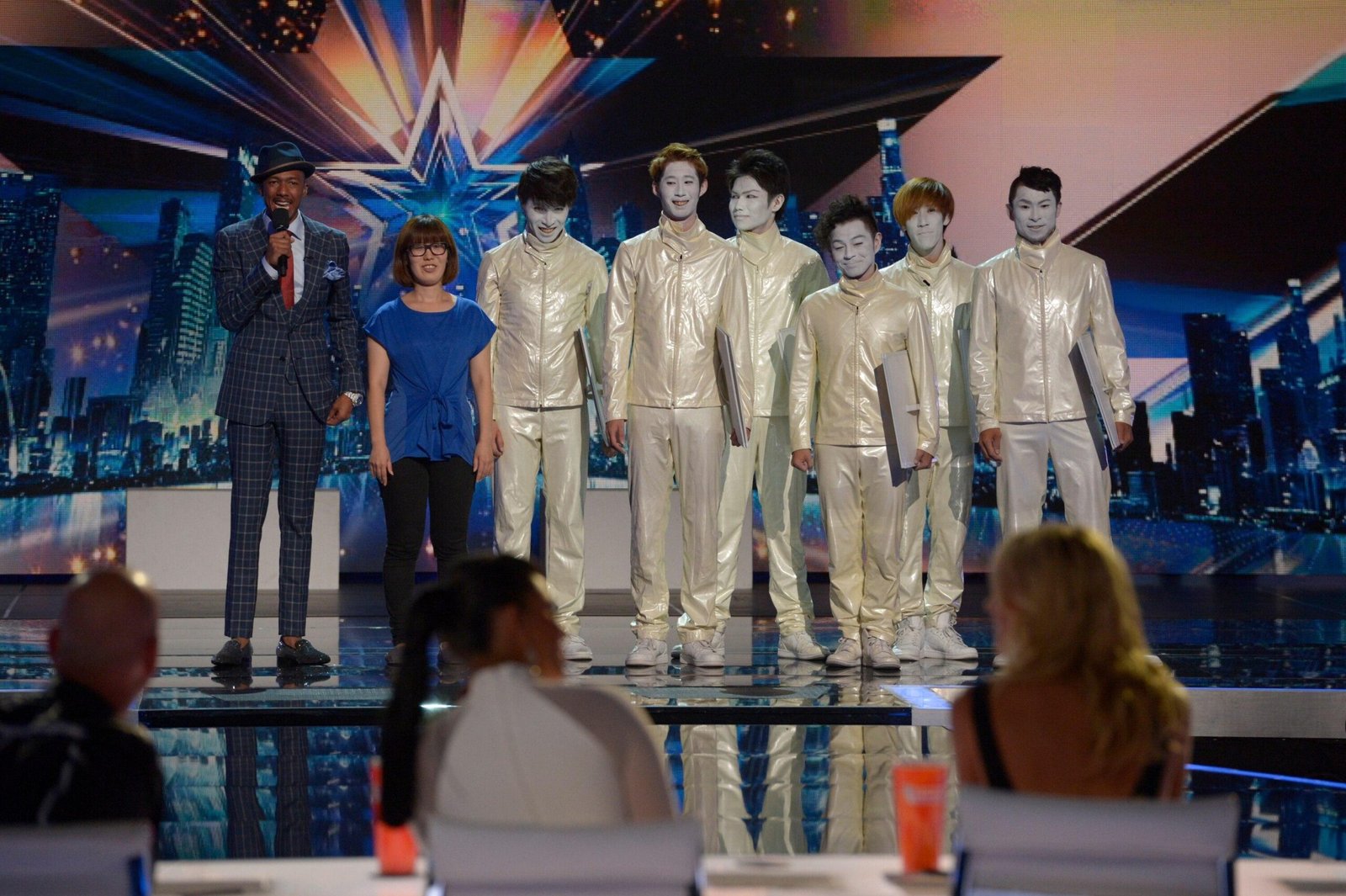

There are some America’s Got Talent performances that entertain the audience for a few minutes—and then there are performances that completely change the way people think about what is possible on a talent-show stage.
Siro-A’s unforgettable performance is one of those acts.
The Japanese performance group stunned viewers with an extraordinary combination of synchronized movement, visual effects, projection mapping, mime, technology and electronic music. Instead of relying on a traditional dance routine, Siro-A transformed the stage into a constantly changing visual world, creating optical illusions that made it difficult to tell where the performers ended and the projections began.
Their appearance on America’s Got Talent Season 10 in 2015 helped introduce the group to an enormous international audience. The performance eventually earned Siro-A a Golden Buzzer from guest judge Piers Morgan, sending them directly onward in the competition.
And years later, the performance continues to attract attention online. In January 2026, the official America’s Got Talent YouTube channel revisited Siro-A’s Golden Buzzer moment, describing the group as a Japanese dance act that created optical illusions through their movements and brought their unusual ideas to life.
A Performance Unlike Anything Else
When Siro-A first appeared on the AGT stage, audiences were immediately confronted with something completely different.
The group wasn’t simply performing choreography in front of a backdrop. Their movements were carefully synchronized with projected images, lights and sound to create the illusion that their bodies were transforming, multiplying, stretching or interacting with objects that weren’t physically there.
The effect was futuristic.
At various points, the performers appeared to disappear into the projections, interact with colorful shapes and become part of the graphics surrounding them. Their precise timing made the visual effects even more convincing.
That precision is one of the biggest reasons the performance stood out.
Projection technology can create impressive visuals on its own, but Siro-A’s performance depended on the performers being perfectly synchronized with those visuals. A small mistake in movement or timing could have broken the illusion.
Instead, the group made the technology feel like an extension of their bodies.
The Story Behind Siro-A
Siro-A’s unusual style didn’t appear overnight.
According to the group’s official biography, Siro-A was formed in 2002 by a group of high-school friends in Sendai, Japan. Over the years, the group developed its distinctive approach to performance, combining visual technology with physical movement and music.
Before reaching America’s Got Talent, Siro-A had already built international experience. Their official history includes performances connected with the Shanghai Expo, Edinburgh Festival Fringe, European tours and extended performances in London.
That background helps explain why their AGT appearance felt so polished.
They weren’t simply experimenting with projections for the first time. They had spent years developing a style that blended dance, mime, technology, comedy and visual storytelling into one performance.
Their work has been described as a non-verbal form of entertainment, allowing the visual storytelling to communicate across language and cultural barriers.
The Golden Buzzer Moment
Siro-A’s journey through Season 10 became especially memorable during the Judge Cuts.
After seeing their increasingly ambitious visual performance, guest judge Piers Morgan decided that the group deserved something much bigger than an ordinary “yes.”
He hit the Golden Buzzer.
The moment sent Siro-A directly forward in the competition and produced one of the season’s most memorable celebrations.
The Golden Buzzer was particularly significant during Season 10 because it had become a mechanism for sending selected acts directly to the live shows.
For Siro-A, the buzzer represented recognition not only for their dancing, but also for their completely original approach to live entertainment.
Why the Performance Went Viral
What makes Siro-A’s performance so shareable is its “How did they do that?” factor.
People watching the performance don’t need to understand Japanese or know anything about dance technique to appreciate it.
The concept is instantly visual.
A performer appears to interact with an animated object.
The screen changes.
The dancer moves.
Suddenly, the performer seems to disappear or transform.
Another image appears.
The entire group moves together with almost impossible precision.
That visual language makes the act accessible to audiences around the world.
It’s also the kind of performance that viewers naturally want to watch a second time. After the initial surprise, people often start looking for clues about how the effects were synchronized with the dancers.
That combination of surprise, technology and human skill is a powerful recipe for viral entertainment.
More Than Technology
It would be easy to look at Siro-A’s performance and think that the projections are the star of the show.
But the technology is only half of the equation.
The performers themselves have to execute the choreography with extraordinary accuracy.
Projection mapping can display an image, but it cannot make a person react at exactly the right moment. Siro-A’s dancers have to understand the rhythm, spacing and timing of every visual sequence.
Their movements become part of the animation.
That is what makes the act different from simply watching a video projected onto a stage.
The audience is watching technology and live human performance interact in real time.
Siro-A’s AGT Journey
Siro-A continued beyond the Golden Buzzer and reached the live stages of America’s Got Talent. Their quarterfinal performance continued the group’s visual style, using projected imagery and synchronized movement to create more optical illusions. The group ultimately reached the semifinals of Season 10.
Although they did not win the entire competition, their impact was much bigger than their final placement.
Siro-A demonstrated that a talent-show act didn’t have to fit neatly into traditional categories such as singing, dancing or magic.
They created their own category.
And that category was built around the meeting point of performance, technology and imagination.
Why Fans Still Remember Siro-A
Years after their original appearance, Siro-A remains one of the more distinctive visual acts associated with America’s Got Talent.
The group showed how a relatively simple stage concept—performers, projections and music—could become something extraordinary when every element was synchronized.
Their Golden Buzzer moment also represents something important about talent competitions: sometimes the most memorable acts aren’t necessarily the ones with the biggest voices or the most dangerous tricks.
Sometimes they’re the acts that make the audience say:
“I’ve never seen anything like this before.”
That’s exactly what Siro-A accomplished.
Their futuristic performance from Season 10 remains a fascinating example of how choreography and technology can be combined to create an experience that feels almost impossible.
And now, with the official AGT channel revisiting the Golden Buzzer performance, a new generation of viewers is discovering why Siro-A once had the entire room watching in disbelief.
🎥 Watch Siro-A’s Golden Buzzer Performance
Official America’s Got Talent video: